
Studio 54 and the Architecture of the Modern Club
Oct
It’s the summer of 1977. New York City was bankrupt, gritty, and teetering on the edge of collapse. The streets were a chaotic mix of blackouts and blaring sirens. Yet, inside a former CBS television studio at 254 West 54th Street, a completely different frequency was being broadcast.
Before it was a television studio, the building was the Gallo Opera House. By the time Steve Rubell and Ian Schrager got their hands on it, it was about to become the epicentre of global nightlife. Studio 54 was not merely a discotheque. It was a cultural phenomenon, a hedonistic playground, and the ultimate celebrity hangout. But to view it solely through the lens of Bianca Jagger riding in on a white horse or Andy Warhol lurking in the shadows is to miss the deeper track.
Studio 54 was a masterclass in spatial design. It was the blueprint for the modern nightclub. The founders did not just throw a party; they engineered an environment. They understood that the physical space, the sonic landscape, and the visual spectacle had to work in perfect harmony to create an immersive experience. They found the groove between exclusivity and accessibility, between the gritty reality of 1970s New York and the glittering fantasy of the disco era. In this post, we are going to remix the history of Studio 54. We will look past the velvet rope and the tabloid headlines to examine the physical architecture, the sensory overload of the sound and light, and the enduring legacy that continues to dictate the design of megaclubs in Ibiza and Las Vegas today.
The Physical Space: Architecting the Ultimate Nightclub
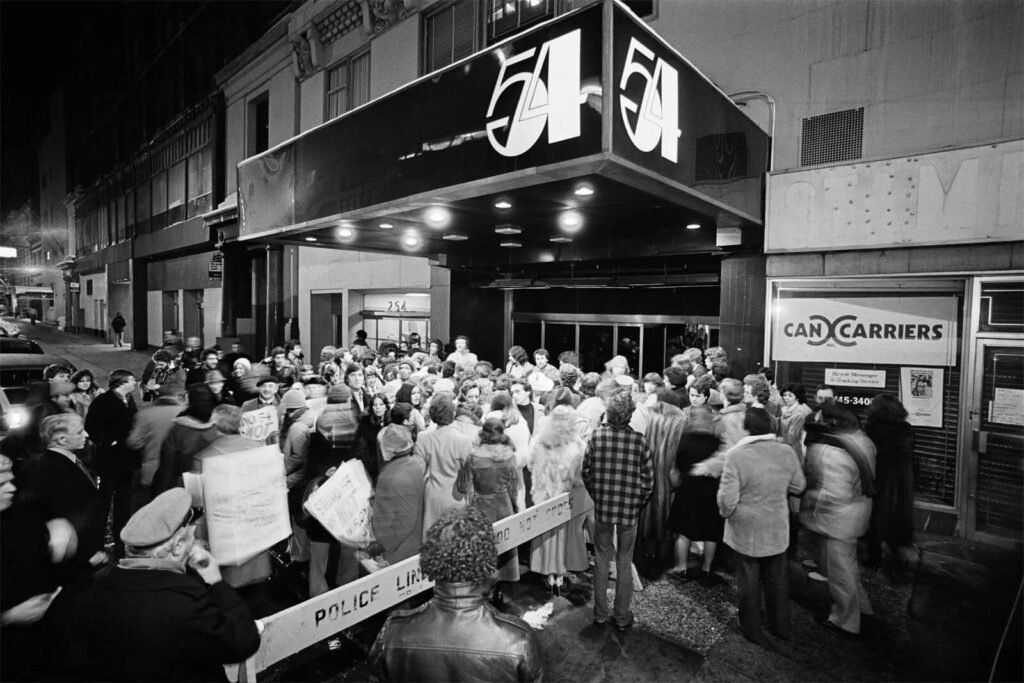
To grasp the genius of Studio 54, we have to look at the physical journey of a guest. The experience began long before anyone stepped onto the dancefloor. It began on the pavement outside. The velvet rope was not just a physical barrier; it was a psychological instrument. Rubell and Schrager weaponised exclusivity. By turning people away at the door, they created an intense desire to get inside. The queue became a theatrical prelude. The door policy was a carefully calibrated mix of celebrities, socialites, beautiful people, and just enough edge to keep the atmosphere electric. This established the VIP culture that dominates nightlife today. The velvet rope was the original algorithm, sorting the crowd and setting the tempo for the night.
Once you passed the door, the architectural layout took over. Schrager, who would later become a legendary hotelier, understood the power of the reveal. The entrance was deliberately compressed. Guests were funnelled through a narrow hallway and a cramped coat check area. This physical compression created a sense of anticipation. It was the visual equivalent of a drum roll before the bass drops. When guests finally emerged from that tight corridor, the main room opened up before them in a breathtaking sweep. The contrast between the claustrophobic entrance and the expansive, glittering main room was a deliberate architectural choice designed to trigger a visceral reaction.
The main room itself was a triumph of interior design. The original opera house balconies were retained but repurposed. The lower balcony became the VIP section, looking down upon the dancefloor like a royal box at the theatre. This elevated the VIPs, literally and metaphorically, making them part of the spectacle while keeping them separated from the general admission crowd. This tiered seating arrangement is a direct ancestor of the bottle service sections we see in every modern superclub. The physical elevation of the VIPs created a social hierarchy that drove table sales and exclusivity for decades to come.
The dancefloor was the heart of the operation, and its layout was meticulously planned. It was not just an open space; it was a sunken pit that forced people to look at each other. The floor was slightly lower than the surrounding seating, creating an amphitheatre effect. Everyone was both the audience and the performer. The materials used in the room amplified this effect. Schrager covered the walls and ceilings in mirrors, chrome, and velvet. The mirrors multiplied the light and the crowd, making the room feel infinitely larger and infinitely more crowded. It was a hall of mirrors that reflected the hedonism back at the revelers.
Then there was the iconic centrepiece. The original design featured a massive, painted backdrop of a man snorting a giant spoonful of cocaine from a crescent moon. This was later replaced by the mechanical “Moonman” or “Spoonman”, a giant animated figure that physically snorted a glowing spoon. This was not just a quirky decoration; it was a focal point that anchored the room. It gave the eye a place to rest and a subject to gossip about. It was a brilliant piece of set design that blurred the lines between a nightclub and a theatrical production.
The physical space of Studio 54 revolutionised club architecture by proving that a nightclub could be a total environment. It was no longer just a room with a bar and a record player. It was a carefully choreographed sequence of spaces designed to manipulate mood, build anticipation, and facilitate social interaction. The flow of the room, the sightlines from the VIP balcony, and the immersive use of reflective materials set a new high fidelity standard for interior design in nightlife. Every modern club that uses a compressed entrance to create a dramatic reveal, or a sunken dancefloor to create an amphitheatre effect, is simply playing a cover version of the Studio 54 original.
The Sonic and Visual Experience: Engineering the Sensory Overload
If the physical space was the skeleton of Studio 54, the sound and lighting were the nervous system. The sensory experience inside the club was engineered with a rigour that was unprecedented in the 1970s. Before Studio 54, the DJ was often an afterthought, hidden in a corner, and the sound system was an afterthought, meant merely to be loud enough to hear over the chatter. Rubell and Schrager flipped the mix. They understood that sound and light were not just accompaniments to the party; they were the party itself.
The sonic experience was spearheaded by the legendary sound designer Richard Long. Long was a pioneer in acoustic engineering, and his work at Studio 54 was a masterclass in audio fidelity. He did not just hang speakers from the ceiling; he custom built a sound system tailored to the specific acoustics of the room. The old opera house had a natural resonance that could easily turn into a muddy echo if not treated correctly. Long used a combination of custom built speakers, strategic placement, and acoustic dampening to ensure that the sound was crystal clear, no matter where you stood in the room.
The bass at Studio 54 was not just heard; it was felt. It was a physical force that resonated in the chest and guided the movement of the crowd. Long designed the system so that the high frequencies were crisp and the low frequencies were deep and punchy, without bleeding into each other. This allowed the complex, layered productions of disco records to be heard in all their glory. The intricate strings, the soaring vocals, and the driving four on the floor kick drum were all rendered with stunning clarity.
You can hear the kind of high fidelity, complex production that defined the Studio 54 sound in tracks like Donna Summer’s “I Feel Love”. The synthesizer bassline is deep and hypnotic, while the ethereal vocals float above it.
Or consider the pristine, rhythmic perfection of Chic’s “Good Times”. The bassline is tight and melodic, the guitar is crisp, and the sound system at 54 would have rendered every single note with absolute precision.
The DJ booth was elevated from a hidden desk to a command centre. It was positioned so the DJ could read the room, but it was also integrated into the visual design of the space. The DJs at Studio 54, legends like Richie Kaczor and Bobby DJ Guttadaro, were not just playing records; they were conducting an orchestra of light and sound. They understood the psychology of the dancefloor. They knew how to build tension, how to release it, and how to keep the energy peaking until the early hours of the morning. The booth was the brain of the operation, and the sound system was the voice.
But sound was only half of the equation. The visual experience at Studio 54 was equally revolutionary. Lighting designer Jules Fisher, a Broadway legend, was brought in to design the lighting rig. Fisher understood that lighting in a nightclub was not about illuminating the room; it was about sculpting the space and the people within it. He used light to create moods, to highlight the architecture, and to transform the room from a sleek lounge into a pulsing, chaotic discotheque.
The centrepiece of the visual experience was, of course, the mirror ball. But at Studio 54, the mirror ball was not just a decoration; it was a kinetic sculpture. Fisher used multiple mirror balls of varying sizes, suspended at different heights, and hit them with precisely angled beams of light. This created a dizzying, immersive effect where the entire room seemed to be spinning. The light fractured and bounced off the mirrored walls, enveloping the dancers in a cocoon of glittering light. It was a visual representation of the disco dream, a physical manifestation of the music.
Fisher also used coloured gels, strobes, and follow spots to create dynamic visual cues that matched the music. When the tempo of the track increased, the lighting would flash in time with the beat. When the music dropped into a slow, sensual groove, the lights would dim to a deep, sultry red or blue. The integration of the lighting cues with the musical arrangement was a groundbreaking concept. It meant that the visual and sonic experiences were perfectly synchronised, creating a truly immersive environment.
This level of integration is clearly audible and visible in the live energy of a track like Sylvester’s “You Make Me Feel (Mighty Real)”. The soaring, gospel infused vocals and the relentless, driving piano riff demand a visual spectacle that matches the sonic intensity.
Or Grace Jones’s “Pull Up to the Bumper”, with its heavy, reggae infused bassline and commanding vocal delivery. The lighting at 54 would have shifted to match the dark, sexy, and powerful frequency of the track.
The sonic and visual experience of Studio 54 proved that a nightclub could be a piece of total art. It was not enough to just play good music; the music had to be delivered with pristine fidelity. It was not enough to just have lights; the lights had to be choreographed to the music. The DJ, the sound engineer, and the lighting designer were all working together to create a single, unified experience. This holistic approach to sensory design is the direct ancestor of the immersive, multi sensory experiences we expect in modern nightlife.
The Enduring Frequency of Studio 54
Studio 54 officially closed its doors in 1980, but its frequency has never faded from the cultural airwaves. The club was a flash in the pan, burning bright and fast, but the blueprint it created has been remastered and reissued countless times. The physical design, the VIP culture, and the integration of sound and light established by Rubell and Schrager are the foundational tracks for the modern megaclub industry.
Look at the superclubs of Ibiza. Venues like Pacha, Amnesia, and Hi Ibiza are the direct descendants of Studio 54. They have taken the blueprint and scaled it up for the 21st century. The compressed entrance and the dramatic reveal are still there, designed to build anticipation before the drop. The tiered VIP seating, looking down upon the main room, is a direct lift from the 54 balcony. The dancefloor is still the focal point, surrounded by immersive visual installations that react to the music. The difference is the scale and the technology. Where Studio 54 had a single mirror ball, modern clubs have massive, kinetic LED chandeliers and laser arrays that can map the entire room. But the underlying concept remains exactly the same. The goal is still to create an immersive, inescapable environment where the outside world ceases to exist.
The same DNA can be found in the megaclubs of Las Vegas. Omnia at Caesars Palace, Hakkasan at the MGM Grand, and Zouk at Resorts World are essentially Studio 54 remixed for the high roller era. The velvet rope has been replaced by the minimum spend on a VIP table, but the psychology of exclusivity is identical. The physical spaces are designed to facilitate both the spectacle of the DJ and the spectacle of the VIPs. The sound systems are custom built by companies like Funktion One and d&b audiotechnik, pushing the boundaries of acoustic engineering just as Richard Long did in 1977. The lighting rigs are computer controlled, creating visual narratives that sync perfectly with the BPM of the tracks.
Studio 54 taught the world that a nightclub is not just a place to drink and dance. It is a theatre of the night. It is a place where architecture, sound, light, and social dynamics are carefully orchestrated to create a temporary utopia. The founders understood that people do not just go to a club to hear music; they go to feel the music, to see the music, and to be part of the music. They engineered an environment that bypassed the intellect and spoke directly to the body.
As we look at the current landscape of global nightlife, from the underground warehouses of Berlin to the massive festival stages of Tomorrowland, the ghost of Studio 54 is always there. It is in the way the lights cut through the haze. It is in the way the bass hits the chest. It is in the way the VIP section is elevated above the crowd. The technology has evolved, the music has changed, and the fashion has been updated, but the core frequency remains the same. Studio 54 dropped the needle on the modern nightclub experience, and the track is still playing. The hedonism may have been specific to the 1970s, but the design is timeless. It is a high fidelity classic that will continue to influence the rhythm of nightlife for generations to come.
References
- Bego, Mark. (2000). Studio 54: The Inside Story of the World’s Most Famous Disco. Citadel Press.
- Levy, Shawn. (2010). Disco: The 70s Experience. running Press.
- Schrager, Ian. (2018). “The Story of Studio 54.” Architectural Digest.
- Long, Richard. (1978). “Acoustic Design in Nightclub Environments.” Journal of the Audio Engineering Society.
- Fisher, Jules. (2005). Jules Fisher: Theatrical Lighting Designer. Theatre Communications Group.