
From B-Boy to High Fashion: The Symbiotic Evolution of Hip-Hop and Streetwear
Oct
Dropping the needle on the history of hip-hop means listening closely to the rhythm of the streets. Before the genre became the dominant cultural force it is today, it was a marginalised subculture shouting into a void.
The 1970s and 1980s in New York City were defined by economic decay and systemic neglect. The Bronx was literally burning, and the mainstream media was busy looking the other way. But in the middle of that concrete decay, a new frequency was being broadcast. Hip-hop was not just a musical movement. It was a total cultural reset. And at the very centre of that reset was fashion.
For the pioneers of this culture, clothing was never just about covering the body. It was a megaphone. It was a declaration of visibility in a society that actively tried to render them invisible. When the doors to the exclusive clubs and the high-end boutiques of Manhattan were locked to them, the architects of hip-hop simply built their own rooms. They found the groove by creating a visual language that was loud, unapologetic, and entirely their own.
This early era of hip-hop fashion was defined by a fierce rejection of mainstream exclusion. If the establishment said certain styles were not for them, they wore those styles with double the swagger. We saw the rise of logomania, where brand names were worn like armour. We saw the elevation of the tracksuit from gym wear to a uniform of cool. We saw custom gear that blurred the lines between sportswear, luxury, and pure art. Hip-hop was setting the tempo for a new kind of luxury, one based on cultural capital rather than old-money pedigree.
To understand how we got from the block parties of the South Bronx to the front rows of Paris Fashion Week, we have to trace the samples. We have to look at the bootleggers, the sneakerheads, and the visionaries who took the raw, unpolished sound of the streets and remastered it for the global stage. This is the story of how hip-hop did not just adapt to the fashion industry. It completely rewrote the rules of the game.
The Bootleg Era and Dapper Dan
If hip-hop music was built on the art of the sample, hip-hop fashion was built on the art of the bootleg. And no one sampled the fashion world quite like Daniel Day, universally known as Dapper Dan.
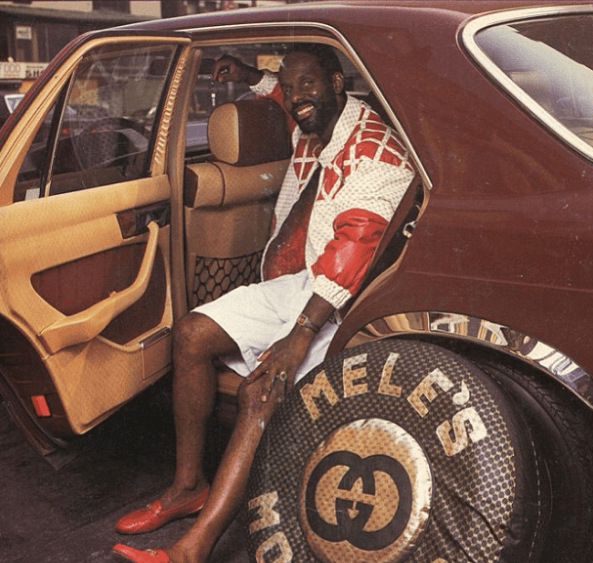
Operating out of Harlem on 125th Street, Dapper Dan’s boutique was the ultimate creative laboratory. In the 1980s, the high-fashion houses of Europe looked down on hip-hop. They viewed the culture as too gritty, too loud, and entirely outside their target demographic. But Dapper Dan saw something they missed. He saw the hunger. He saw the desire for luxury, and he realised that if the gates were locked, he would just pick the lock.
Dapper Dan began taking the iconic monograms of brands like Gucci, Fendi, and Louis Vuitton and printing them onto custom leather. He did not just slap a logo on a shirt. He completely deconstructed and rebuilt the garments. He took the classic silhouettes of European luxury and infused them with the oversized, flamboyant energy of the Harlem streets. He created tracksuits, bomber jackets, and dresses that were entirely unique. He was remixing high fashion, taking the A-side of Parisian couture and flipping it into a B-side that ruled the New York block.
The cultural weight of this cannot be overstated. Rappers like Rakim, Big Daddy Kane, and LL Cool J, as well as boxing champion Mike Tyson, all wore Dapper Dan. When they stepped on stage or into the ring wearing a custom Fendi tracksuit, they were projecting an image of ultimate success. They were telling the world that they had made it, even if the traditional fashion elite refused to acknowledge them.
Naturally, the luxury houses eventually caught on. And they were not happy. In 1989, Fendi and other brands sued Dapper Dan, forcing him to close his boutique. The high-fashion establishment tried to silence the remix. They wanted to protect their pristine image from the grit of the streets. But you cannot stop a frequency once it has been broadcast. The desire for that custom, oversized, logo-heavy aesthetic had already been planted in the cultural consciousness.
The ultimate irony, of course, is that decades later, those exact same luxury houses realised they needed the energy that Dapper Dan had cultivated. Gucci eventually admitted their early designs had “borrowed” from Dapper Dan, and in 2018, they officially partnered with him to open a new boutique in Harlem. It was a full-circle moment. The establishment finally realised that the culture they once tried to shut out was actually the key to their future relevance. Dapper Dan forced high fashion to acknowledge the culture, proving that true style cannot be gatekept. It will always find a way to amplify its own sound.
The Sneakerhead Phenomenon
If clothing was the melody of hip-hop fashion, sneakers were the bassline. They provided the foundation, the low-end rumble that kept the entire culture moving. The cultural weight of sneakers in hip-hop is impossible to overstate. What started as practical footwear for breakdancers and basketball players evolved into a multi-billion-dollar global phenomenon.
The genesis of this movement can be traced back to a single, pivotal track. In 1986, Run-DMC released “My Adidas”. The song was a love letter to the Superstar sneaker, celebrating the shell toes and the creased leather. But the real magic happened when the group took the track to Madison Square Garden. They asked the crowd to hold their shoes in the air. Thousands of Adidas lifted into the rafters. It was a visual representation of the culture’s purchasing power. Shortly after, Adidas signed Run-DMC to a million-dollar endorsement deal. It was the first time a non-athletic brand had partnered with hip-hop artists. The needle had been dropped on a brand-new era.
From there, the sneaker culture found its groove and never stopped running. The introduction of the Air Jordan line changed the rhythm entirely. Michael Jordan was the ultimate crossover star, and his shoes became the ultimate status symbol. For kids in the inner city, a fresh pair of Jordans was not just footwear. It was armour. It was a ticket to respect. The culture developed an obsessive relationship with keeping the shoes clean, lacing them tight, and treating them with a reverence usually reserved for religious artefacts.
As the decades passed, this obsession evolved into the modern sneakerhead and hypebeast phenomenon. The introduction of limited-edition drops created a scarcity model that drove demand through the roof. Brands like Nike, through collaborations with artists and designers, turned sneakers into wearable art. The resale market exploded, turning shoes into a literal stock market.
Today, the drop culture is the dominant rhythm of the fashion industry. Brands release limited quantities of sneakers at specific times, creating a frenzy of anticipation. The modern consumer does not just buy a product. They buy into the hype, the story, and the cultural cachet of the release. The sneakerhead phenomenon proved that hip-hop could dictate consumer behaviour on a global scale. It showed the fashion industry that the streets had the power to create demand out of thin air, simply by setting the right tempo.
You can feel the bassline of this evolution in the music that soundtracked it. From the early days of hip-hop to the modern trap anthems, the shout-outs to fresh sneakers remain a constant hook. It is a testament to the fact that in hip-hop, what is on your feet is just as important as the words coming out of your mouth.
Taking Over the Runway
For a long time, the relationship between hip-hop and high fashion was a one-way street. The artists would reference the luxury brands in their lyrics, and the brands would quietly collect the cultural capital without offering anything in return. Hip-hop was the muse, but it was never the architect. That dynamic shifted permanently when the artists and designers of the culture decided to take over the runway.
The transition began in earnest with Kanye West. Long before his personal controversies, West was a visionary who saw the seamless blend between streetwear and high fashion. He refused to accept the boundary between the two. His Yeezy brand, particularly his partnership with Adidas, introduced a new silhouette to the world. The muted tones, the oversized fits, and the dystopian aesthetic of Yeezy completely remastered the look of the 2010s. Kanye proved that a hip-hop artist could be a legitimate fashion designer, capable of dictating global trends and shifting the entire aesthetic of the industry.
But the ultimate crossover moment arrived with the late, great Virgil Abloh. Abloh was the bridge between the underground and the establishment. Coming up through the hip-hop scene as Kanye West’s creative director, Abloh understood the language of the streets. When he launched Off-White, he brought the DIY ethos of punk and the sampling culture of hip-hop to high fashion. He used quotation marks, zip ties, and industrial belts to deconstruct luxury.
Then, in 2018, the ultimate paradigm shift occurred. Virgil Abloh was named the artistic director of menswear at Louis Vuitton. This was not just a job appointment. It was a cultural coronation. A kid from the hip-hop and streetwear scene was now at the helm of one of the oldest, most prestigious luxury houses in the world. His debut show for Louis Vuitton featured a rainbow runway and a guest list that included every major figure in hip-hop. It was a visual declaration that the culture had arrived at the very top of the mountain. Virgil did not just adapt to the legacy of Louis Vuitton. He injected it with the raw, unfiltered energy of the streets, proving that luxury and streetwear were no longer two different genres. They were the same track.
Following Virgil’s tragic passing, the torch was passed to Pharrell Williams. Pharrell has always been a style icon, a man who could make a billion-dollar bag look like a natural extension of his personal groove. When he took the creative director seat for Louis Vuitton menswear, he brought a sense of joy, colour, and musicality to the brand. His debut show in Paris was a spectacular celebration of hip-hop culture, featuring a massive choir and a performance that felt more like a historic concert than a fashion show. Pharrell’s appointment solidified the reality that hip-hop is no longer just influencing luxury fashion. It is running it.
These creative directors did not just get hired to make clothes. They were hired to translate the culture for a global audience. They understood that the youth of the world were not looking for the stiff, traditional tailoring of the past. They wanted clothes that moved, that breathed, that had the rhythm of the streets. By taking the creative director seats, they ensured that the frequency of hip-hop would be broadcast from the highest runways in the world.
The Track is Still Playing
Looking back at the journey from the block parties of the Bronx to the catwalks of Paris, it is clear that hip-hop did not just adapt to the fashion industry. It completely rewrote the rulebook. The culture took the raw materials of marginalisation and spun them into a global empire of style.
It started with a rejection. When the mainstream said no, hip-hop said yes, louder and with more flair. Dapper Dan sampled the luxury logos and created a new visual language. The sneakerheads turned athletic footwear into a global currency of cool. And the visionaries like Virgil Abloh and Pharrell Williams took the creative director seats, ensuring that the culture’s voice would echo through the halls of legacy luxury.
Hip-hop taught the fashion industry that true luxury is not just about the price tag or the heritage of the house. It is about cultural relevance. It is about the ability to connect with the youth, to dictate the rhythm of the streets, and to make people feel something when they put on a garment. The fashion industry tried to ignore hip-hop, then it tried to co-opt it, and finally, it had to surrender to it.
The symbiotic evolution of hip-hop and streetwear is a masterclass in cultural power. It shows that when you create something authentic, something that speaks directly to the soul of the people, no gatekeeper can keep it out. The frequency is too strong. The groove is too deep.
As we look to the future, the track is still playing. The needle has not lifted. The next generation of designers, artists, and creatives are already in the lab, finding new ways to sample the past and remix the future. Hip-hop fashion is no longer a subculture. It is the main stage. And the world is finally dancing to its beat.
References
- Chang, Jeff. Can’t Stop Won’t Stop: A History of the Hip-Hop Generation. St. Martin’s Press, 2005.
- Day, Dapper, and Rusty La Rue. Dapper Dan: Handcrafted Memories from the Harlem Shop. Rizzoli, 2020.
- Unorthodox Styles? The World According to Dapper Dan. The Business of Fashion, 2019.
- Bobbito, Bob. Where’d You Get Those: New York City’s Sneaker Culture 1960-1987. PowerHouse Books, 2006.
- Abloh, Virgil. Figures of Speech. Prestel, 2019.
- The Gospel of Hip Hop: First Instrument. Edited by Kool Keith, PowerHouse Books, 2009.