
From Warehouse Streetwear to Festival Glam: The Evolution of House Fashion
Oct
There is a rhythm to getting dressed for the night. You know the one – the bassline hums in your chest before you have even left home and the mirror becomes a turntable, spinning through options until something clicks. House music has never been just about the sound. It has always been a full sensory frequency, and what you wore to the party was as much a part of the groove as the kick drum.
This is the story of how house fashion evolved from baggy jeans and second-hand tees on the concrete floors of Chicago warehouses to the sequined, logo-heavy spectacle of the 2010s festival circuit, and finally to where we find ourselves now, rifling through the archives, pulling the past back into the present like a DJ digging through crates for that forgotten white label.
Chapter One: Sweat, Concrete, and Second-Hand Cotton (1980s to Mid-1990s)
Chicago in the mid-1980s. The Warehouse. The Music Box. These were not glamorous spaces. They were industrial, humid, packed shoulder to shoulder with bodies moving to the four-on-the-floor pulse that Frankie Knuckles was laying down like a sermon. You did not dress for the cameras because there were no cameras. You dressed to survive the night.
The uniform was functional. Baggy jeans, oversized t-shirts, trainers with flat soles that could grip a slick floor. Tracksuit tops zipped halfway, sweatshirts tied around waists. The palette was muted, pulled straight from the racks of thrift stores and charity shops because that was what people could afford. There was no brand consciousness in the way we understand it now. Nobody was wearing a logo to signal belonging to a tribe. The tribe was the room itself, and the room did not care what label was stitched into your collar.
As the sound crossed the Atlantic and landed in the UK, the fashion shifted slightly but kept its roots in practicality. The Second Summer of Love in 1988 was less a fashion movement and more a spontaneous visual eruption. The smiley face, lifted from a 1960s graphic by Harvey Ball and splashed across everything from T-shirts to flyers, became the defining symbol of acid house in the UK. It was simple, it was cheap to reproduce, and it communicated everything you needed to know about the mood of the moment. But all the while the underlying philosophy remained the same, you wore what you could move in. You wore what you could sweat through and wash out and wear again the following weekend. Listen to the rawness of it – put on Marshall Jefferson’s “Move Your Body” and you can practically smell the damp brick walls and feel the condensation dripping from the ceiling.
In Detroit, the techno side of the family tree was growing its own visual language, slightly sharper, slightly more futuristic, but still grounded in the everyday. Carhartt jackets, work boots, plain tees. The aesthetic of the working class repurposed for the dancefloor. As Dan Sicko writes in Techno Rebels, the Detroit scene was deeply tied to the city’s industrial identity, and the clothing reflected that blue-collar honesty.
What is important to recognise about this era is that the fashion was not a costume. It was not a performance of identity designed for consumption. It was simply what people wore. The beauty of it was its accident, its lack of intention. A pair of wide-leg JNCO jeans or an oversized flannel shirt was not a “look” yet. It was just Tuesday.
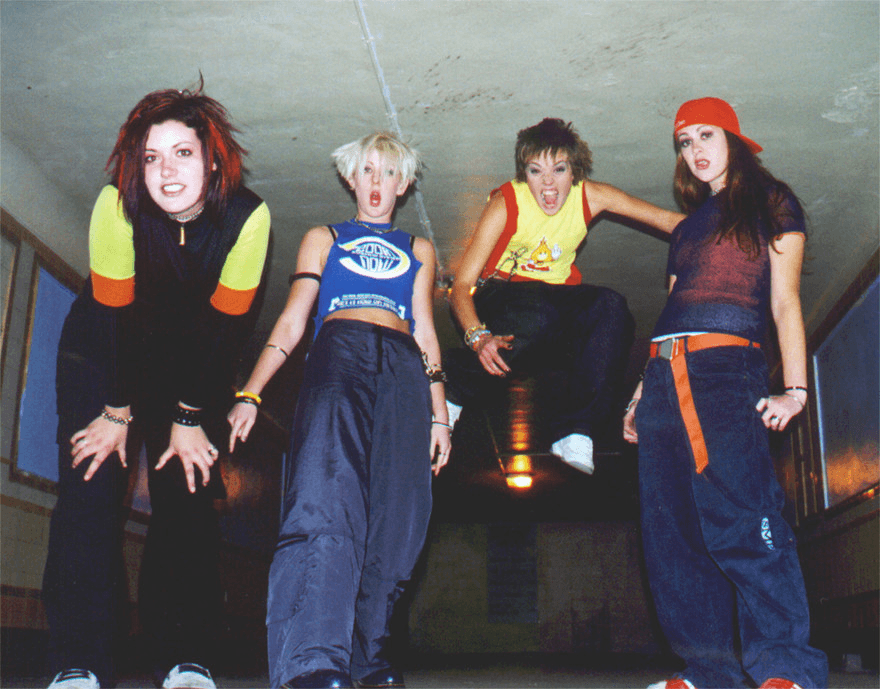
In the UK rave scene, the fashion became slightly more theatrical as the 1990s rolled in. The club kid aesthetic started to bubble up in London and Manchester. Think Boy George’s orbit, the Blitz Club legacy bleeding into the warehouse parties. People started experimenting with colour, with texture, with the absurd. But even at its most flamboyant, the 90s rave wardrobe was assembled from car boot sales and market stalls, not from designer rails. Tracks like “Show Me Love” from Robin S, are the sound of a generation finding its feet, and the fashion was the same: unpolished, earnest, deeply human.
Chapter Two: The Main Stage Makeover (2000s to Mid-2010s)
Something happened when house music found the festival main stage. The sound got bigger, the crowds got larger, and the fashion underwent a full remaster.
By the late 2000s and into the 2010s, the EDM boom had turned DJs into global celebrities. The underground warehouse had been replaced by the Las Vegas residency, the Ibiza superclub, the Tomorrowland main stage. And with that shift came a new visual language, one that borrowed heavily from rock star mythology and luxury branding.
The DJ superstar era brought us the uniform of the headliner. Black t-shirts with cryptic logos. Leather jackets. Designer sunglasses worn indoors at 2 AM. The silhouette narrowed. The baggy jeans of the 90s were swapped for slim-fit denim and tailored joggers. Sneakers became collectible objects, hyped drops from Nike and Adidas that retailed for hundreds and resold for thousands.
This was the era when the DJ booth became a runway. Swedish House Mafia performed in matching black, looking less like house music producers and more like a Scandinavian rock band on a stadium tour. David Guetta leaned into the pop crossover with a polished, clean-cut aesthetic that mirrored the radio-friendly sheen of his productions. Deadmau5 hid behind a helmet, turning anonymity itself into a brand.
The crowd changed too. Festival fashion became its own economy. Flower crowns, neon body paint, kandi bracelets, fishnet stockings, platform boots. The rave aesthetic was still present, but it had been filtered through a commercial lens, packaged and sold back to a generation that had discovered dance music through YouTube compilations and Spotify playlists rather than through a mate handing them a white label at a record shop.
There is nothing inherently wrong with this evolution. Fashion moves. Scenes grow. But something was lost in the translation. The intimacy of the 90s warehouse, the sense that you were part of a secret, gave way to a spectacle that felt designed to be photographed and shared. The fashion became aspirational rather than accidental. You were no longer dressing for the dancefloor. You were dressing for the feed.
As Simon Reynolds observes in Energy Flash, the commercialisation of rave culture has always carried a tension between the communal and the commodified, and the 2010s festival era was perhaps the clearest expression of that pull. The music was still house, broadly speaking, but the visual culture around it had been equalised and compressed, all the rough edges smoothed out for mass consumption.
That melody still hits. But close your eyes and picture the crowd. The sea of phones held aloft. The branded stage backdrops. The fashion had become part of the product, and the product was everywhere.
Chapter Three: The Rewind, the Remix, the Return (Late 2010s to Now)
And then, as it always does, the pendulum swung back.
Somewhere around 2019, and then accelerating hard through the pandemic years, a new generation of dancers and producers started reaching backwards. They pulled the 90s out of the archive and held it up to the light. Baggy jeans returned. Bucket hats came back into rotation. The oversized silhouette, the thrifted graphic tee, the scuffed trainer, all of it found its way back onto the dancefloor and, crucially, back onto the internet.
But this was not a simple copy and paste. The current wave of house fashion is a remix, not a reissue. It takes the raw materials of 90s rave and Y2K club kid culture and recontextualises them through a contemporary lens. The nostalgia is real, but it is layered with irony, with self-awareness, with the knowledge that we are quoting a past we may not have even lived through firsthand.
Look at the visual world of artists like Bicep, whose live shows and merchandise draw heavily on 90s graphic design, all pixelated fonts and VHS degradation. Look at Fred again.., whose entire aesthetic feels like a love letter to the intimacy of early rave culture, all handheld camera footage and handwritten notes and the kind of emotional rawness that the EDM era tried to polish away.
The fashion that surrounds this new wave is deliberately lo-fi. It rejects the sleekness of the 2010s in favour of something that feels lived in, borrowed, found. Vintage sportswear. Faded band tees from clubs that closed twenty years ago. Chunky trainers that look like they have been pulled from a skip outside a 1997 warehouse party. The Y2K influence adds a layer of playful futurism, the metallic fabrics and tiny sunglasses and butterfly clips of the turn of the millennium reinterpreted by a generation that grew up on Depop and TikTok.
Peggy Gou is a perfect case study. Her fashion sense bridges decades, pulling from 90s minimalism and early 2000s club culture while maintaining a sharpness that feels entirely her own. She has collaborated with luxury brands, yes, but the references always point back to the dancefloor, back to the functional beauty of rave wear.
What is fascinating about this current moment is how the cycle has become self-aware. We know we are being nostalgic. We know the baggy jeans are a reference, not a default. And yet the feeling they produce is genuine. There is something about pulling on a pair of wide-leg cargos and an old football shirt that connects you to a lineage, a frequency that has been humming beneath the surface for forty years.
The pandemic played a role here, too. When the clubs closed, people turned to the archives. Documentaries like Maestro and I Was There When House Took Over the World found new audiences. Instagram accounts dedicated to 90s rave photography gained hundreds of thousands of followers. The fashion became a way of keeping the culture alive when the physical spaces were gone, a way of wearing the memory of the dancefloor on your back until the doors opened again.
Now that they have reopened, the aesthetic has only deepened. The new generation of clubbers in London, Berlin, New York, and beyond are dressing with a reverence for the past that feels both sincere and creative. They are not cosplaying the 90s. They are sampling it, chopping it up, looping the best bits and adding their own drums on top.
That collaboration right there is the metaphor made flesh. The old guard and the new blood, finding the groove together, wearing their influences openly and honestly.
The Outro: The Beat Goes On
House fashion has never been static. It has always moved with the music, responding to the room, the city, the decade. From the thrift-store practicality of 1980s Chicago to the branded spectacle of 2010s festival culture to the knowing, layered nostalgia of today, the visual language of house music tells the story of a culture that refuses to stand still.
What remains constant is the impulse behind it all. The desire to belong to something bigger than yourself. The need to express, through fabric and silhouette and colour, the feeling of a bassline moving through your body at 3 AM. The fashion changes, but the frequency does not.
So next time you are getting ready for a night out, take a second. Look in the mirror. Listen for the groove. You are part of a long, beautiful, baggy-jeaned lineage. Hear that soundtrack in your head and wear it well.
References
- Reynolds, S. (2013). Energy Flash: A Journey Through Rave Music and Dance Culture. 2nd edn. London: Faber & Faber.
- Sicko, D. (2010). Techno Rebels: The Renegades of Electronic Funk. 2nd edn. Detroit: Wayne State University Press.
- Brewster, B. and Broughton, F. (2006). Last Night a DJ Saved My Life: The History of the Disc Jockey. Updated edn. London: Headline.
- Rietveld, H.C. (1998). This Is Our House: House Music, Cultural Spaces and Technologies. Aldershot: Ashgate.