
Disco Demolition Night: The Day Rockism Tried to Kill Dance Music
Sep
The air inside Comiskey Park on July 12, 1979, was thick with the smell of stale beer, summer sweat, and impending violence. It was supposed to be a doubleheader between the Chicago White Sox and the Detroit Tigers, a routine midsummer baseball ritual. Instead, it became the site of one of the most infamous promotional stunts in American history.
Steve Dahl, a local radio DJ with a grudge and a megaphone, stood on the field between games. At his feet sat a massive crate of disco records. The crowd, estimated at nearly ninety thousand people, was already buzzing with a chaotic, restless energy. When Dahl finally ignited the explosives, the resulting blast sent a shower of vinyl shrapnel into the humid Chicago night.
What followed was not a celebration, but a full-blown riot. Fans stormed the field, tearing up the base paths, lighting bonfires, and ultimately forcing the cancellation of the second game. To the casual observer, or to the mainstream media the next morning, Disco Demolition Night was a quirky, slightly out-of-control piece of sports and music trivia. It was framed as the moment the rock-and-roll establishment finally pushed back against the glittering, synthetic excess of the disco era.
But if you drop the needle on this event and listen closely to the deep cuts, a much darker frequency emerges. Disco Demolition Night was not merely a clash of musical genres. It was a cultural pressure cooker. The explosive climax at Comiskey Park was a flashpoint for the racial, homophobic, and cultural tensions that were boiling over in the late seventies. To understand the true legacy of that night, we have to look past the surface narrative of angry rock fans and examine the ugly undertones of the anti-disco movement. We also have to look at the paradoxical aftermath, exploring how this mainstream rejection forced marginalised producers to take their music underground, directly catalysing the raw, DIY sound of early house and techno.
The Surface Narrative: The Rock vs. Disco Divide
To understand the explosion, we first need to find the groove of the era. The late seventies were a time of profound cultural exhaustion. The country was dealing with stagflation, an energy crisis, and a lingering hangover from the idealism of the sixties. Into this malaise stepped disco. With its four-on-the-floor kick drum, sweeping string sections, and relentless tempo, disco was an escapist fantasy. It was loud, it was proud, and it was making an unprecedented amount of money. By 1978, disco had completely saturated the mainstream. It was in the movies, on the radio, and in the supermarkets.
For the traditional rock establishment, this saturation felt like an invasion. Rock music, which had built its identity on rebellion and authenticity, suddenly found itself pushed to the margins of the pop charts. The narrative was simple. Rock was real, played by bands with guitars and sweat. Disco was fake, manufactured by producers in sterile studios and performed by singers who just lip-synced over pre-recorded tracks.
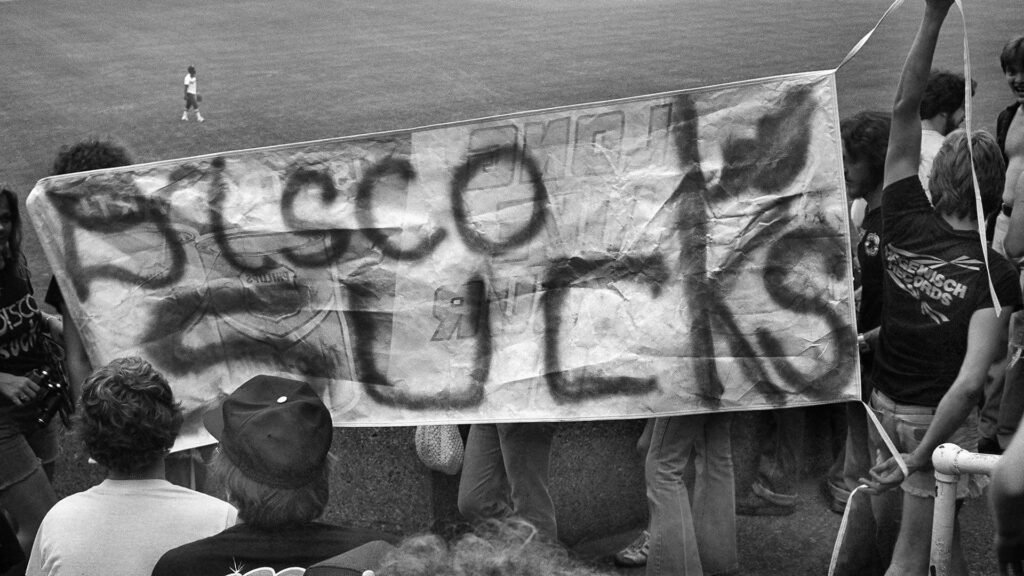
Steve Dahl became the unwitting figurehead for this backlash. In late 1978, the Chicago radio station WDAI fired Dahl and switched to an all-disco format. Humiliated and angry, Dahl landed at a rival station, WLUP, and launched a crusade. He started the “Disco Sucks” movement, encouraging his listeners to bring their disco records to the station to be destroyed on air. The campaign was a massive ratings success, tapping into a genuine frustration among young, white, working-class rock fans who felt their culture was being overwritten.
The climax of this campaign was Disco Demolition Night. The White Sox, struggling to sell tickets, partnered with Dahl. The promo was simple. Bring a disco record to the gate, and you get in for ninety-eight cents. The team expected a modest turnout. Maybe fifty thousand people. Instead, nearly ninety thousand showed up.
The sheer scale of the crowd overwhelmed the stadium. People were climbing fences, sitting in the aisles, and packing the outfield. The first game was played, but the crowd was entirely focused on the intermission. The White Sox lost, but nobody cared. When Dahl took the field between games, the atmosphere shifted from a baseball game to a mob rally. The explosion of the records was the spark. The crowd rushed the field, destroying everything in their path. The second game was forfeited. The mainstream press had their headline. Rock had won. Disco was dead.
But this surface narrative is a carefully remastered version of history. It ignores the deep, dissonant chords playing just beneath the melody.
The Subtext: Unpacking the Racist and Homophobic Undertones
If we isolate the vocal tracks of the “Disco Sucks” movement, the lyrics reveal a deeply prejudiced subtext. Disco was not just a genre of music. It was the cultural output of marginalised communities. The architects of disco were primarily Black, Latino, and queer producers, DJs, and musicians in cities like New York, Philadelphia, and Chicago. Clubs like the Sanctuary, the Loft, and Studio 54 were safe havens for these communities, places where they could express themselves freely away from the hostility of the mainstream world.
When rock fans complained that disco was “mechanical” or “not real music,” they were often using coded language. The insistence on live instruments and traditional band structures was a defence of the white, male-dominated rock paradigm. Disco, with its emphasis on the DJ, the remixer, and the producer, challenged the traditional hierarchy of musical creation. It suggested that the person curating and manipulating the sound was just as much an artist as the person strumming the guitar. To the traditional rock establishment, this was a threat to their cultural authority.
The homophobia of the movement was even less coded. The rhetoric used to describe disco was frequently laced with anti-gay slurs. The very aesthetics of disco, the glitter, the flamboyant fashion, the emphasis on dancing and physical liberation, were deeply tied to gay culture. When the crowd at Comiskey Park chanted “Disco sucks,” it was often accompanied by chants of “Faggots” and other homophobic epithets. The burning of the records was a deeply violent visual. It echoed the historical imagery of book burnings and hate crimes. It was a public execution of a culture that the mainstream found uncomfortable.
The media played a crucial role in framing this prejudice as a legitimate grassroots backlash. Mainstream rock magazines and newspapers covered the “Disco Sucks” movement with a wink and a nod. They treated it as a fun, rebellious pushback against corporate pop music. They largely ignored the ugly reality of who was actually making the music and who was actually burning it. By framing the riot as a simple generational or stylistic clash, the media sanitized the racism and homophobia at the core of the event. They allowed white, straight rock fans to express their prejudices under the acceptable guise of musical criticism.
This cultural erasure had immediate consequences. In the aftermath of Comiskey Park, radio stations across the country panicked. The “Disco Sucks” movement gave them the excuse they needed to purge the genre from their playlists. Overnight, the music of Black, Latino, and queer artists was stripped from the airwaves. The mainstream door was slammed shut. The frequency was jammed. But the music did not stop. It just changed channels.
The Underground Mutation: From the Ashes to the Warehouse
The paradox of Disco Demolition Night is that the mainstream attempt to kill disco actually forced it to evolve. By pushing the music out of the commercial spotlight, the backlash forced marginalised producers and DJs to take their culture back underground. They could no longer rely on major label budgets, orchestral arrangements, or mainstream radio play. They had to find a new groove, and in doing so, they birthed the future of electronic dance music.
In cities like Chicago, Detroit, and New York, the disco scene retreated to the warehouses, the basements, and the underground clubs. The music was remastered for a new environment. Without the budget for live string sections and massive production teams, DJs and producers turned to technology. They embraced the drum machine. The Roland TR-808 and TR-909 became the new rhythm section. These machines allowed producers to create heavy, synthetic beats that were louder, harder, and more relentless than anything a live drummer could play.
In Chicago, a DJ named Frankie Knuckles was holding down a residency at a club called the Warehouse. The patrons, mostly Black and gay, were looking for a sound that reflected their reality. Knuckles began taking classic disco records, isolating the drum breaks, and extending them using reel-to-reel tape machines. He layered in heavy, synthetic basslines and stripped away the glossy pop vocals. The result was a raw, hypnotic, and deeply physical sound. The kids started calling it “house” music, named after the club where it was born.
House music was the direct descendant of disco, but it was stripped of its mainstream bloat. It was a DIY response to exclusion. The producers did not have access to high-end studios, so they made magic with cheap synthesizers and samplers. The music was a reflection of the marginalised communities that created it. It was resilient, it was innovative, and it was unapologetically queer and Black.
Meanwhile, in Detroit, a group of young Black kids known as the Belleville Three were listening to the underground sounds coming out of Chicago, as well as the electronic pop of Kraftwerk and the funk of Parliament. They took the four-on-the-floor beat of house and injected it with a futuristic, mechanical soul. They created techno. Like house, techno was a direct response to the cultural landscape of the late seventies and early eighties. It was music for the post-industrial city, created by kids who were excluded from the mainstream rock and pop narratives.
The “Disco Sucks” backlash inadvertently catalysed this evolution. If disco had remained a glossy, mainstream pop product, it might have eventually faded away on its own, a victim of its own overexposure. But by attacking it with such vitriol, the rock establishment gave the creators of disco a reason to fight. They took their music back to the underground, where it could grow without the interference of mainstream executives. They built their own clubs, their own record labels, and their own culture.
The transition from disco to house and techno was not just a change in tempo or instrumentation. It was a shift in power. The DJ became the central figure, the curator of the night. The dance floor became a sacred space for marginalised communities to reclaim their joy. The music was no longer about selling records to the masses. It was about creating a shared, transcendent experience for the tribe.
The Paradox of the Fade Out
Looking back at Disco Demolition Night from the vantage point of the twenty-first century, the event feels like a bizarre, almost surreal piece of theatre. It is easy to laugh at the image of angry rock fans burning ABBA records and tearing up the outfield at a baseball game. It is easy to dismiss it as a quirky footnote in the history of pop culture.
But to do so is to miss the deeper resonance of the event. Comiskey Park was a flashpoint. It was the moment when the cultural tensions of the late seventies reached a boiling point and spilled over into the streets. The anti-disco movement was not just about a dislike of synthesizers and four-on-the-floor beats. It was a reactionary pushback against the increasing visibility and power of Black, Latino, and queer communities. It was an attempt to reassert a traditional, white, heterosexual cultural dominance.
Yet, the ultimate irony of Disco Demolition Night is that it failed in its primary objective. The mainstream media declared disco dead, but the music simply mutated. It went underground, found a new frequency, and remastered itself for the future. The raw, DIY sound of early house and techno was a direct result of the exclusion faced by its creators. The backlash forced them to innovate, to build their own infrastructure, and to create a culture that was entirely their own.
Today, the legacy of disco is everywhere. You can hear it in the pulsing basslines of modern pop, in the intricate percussion of hip-hop, and in the euphoric drops of mainstream electronic dance music. The producers who were chased out of Comiskey Park in 1979 ended up building the foundation for the global dance music industry.
The groove never really died. It just waited for the world to catch up to its tempo. When we analyse the events of July 12, 1979, we must remember that the explosion on the field was not the end of the song. It was just the bridge. And the music that followed was louder, deeper, and more profound than the rock establishment could ever have imagined.
References and Citations
- Lawrence, Tim. Love Saves the Day: A History of American Dance Music Culture, 1970-1979. Duke University Press, 2003. (Provides extensive context on the underground club scene and the cultural significance of disco).
- Brewster, Bill, and Broughton, Frank. Last Night a DJ Saved My Life: The History of the DJ. Grove Press, 2000. (Details the transition from disco to house and the pivotal role of DJs like Frankie Knuckles).
- Reynolds, Simon. Generation Ecstasy: Into the World of Techno and Rave Culture. Routledge, 1998. (Explores the Detroit techno scene and the sociological roots of electronic dance music).
- Shapiro, Peter. Turn the Beat Around: The Secret History of Disco. Faber and Faber, 2005. (Offers a critical look at the commercialisation of disco and the subsequent backlash).
- Snoman, Rick. Dance Music Manual: Tools, Toys, and Techniques. Focal Press, 2009. (Used for technical context regarding the transition from live disco instrumentation to drum machines and synthesizers).